"Prevention" Is Not Supposed to Mean Erasure
 How Autism Disappears Inside the Language of Clean Air
In October 2025 a major Ontario cohort study linked prenatal exposure to fine-particle pollution with a higher chance of an autism diagnosis. The team tracked more than two million births and found that sulfate and ammonium — chemical components of PM2.5 — correlated with slightly higher autism rates, especially in mid- to late pregnancy. Their conclusion: protect fetuses, improve air quality, reduce "risk" of autism.
The Numbers That Erase Us
The harm sits inside that last phrase. Autism enters the narrative not as a population breathing the same polluted air but as a statistical outcome to be avoided. When autism is cast as risk, prevention becomes erasure. Every model that defines autistic existence as a negative endpoint translates difference into damage through numbers that appear neutral. There's a structural incentive: public health and research funding reward projects that show measurable risk reduction, creating pressure to frame difference as pathology.
This critique targets how risk framing functions structurally, not the intentions of the Cloutier authors. Their study follows accepted public health conventions — but those conventions themselves contain the bias this essay examines.
Who Benefits From Erasure
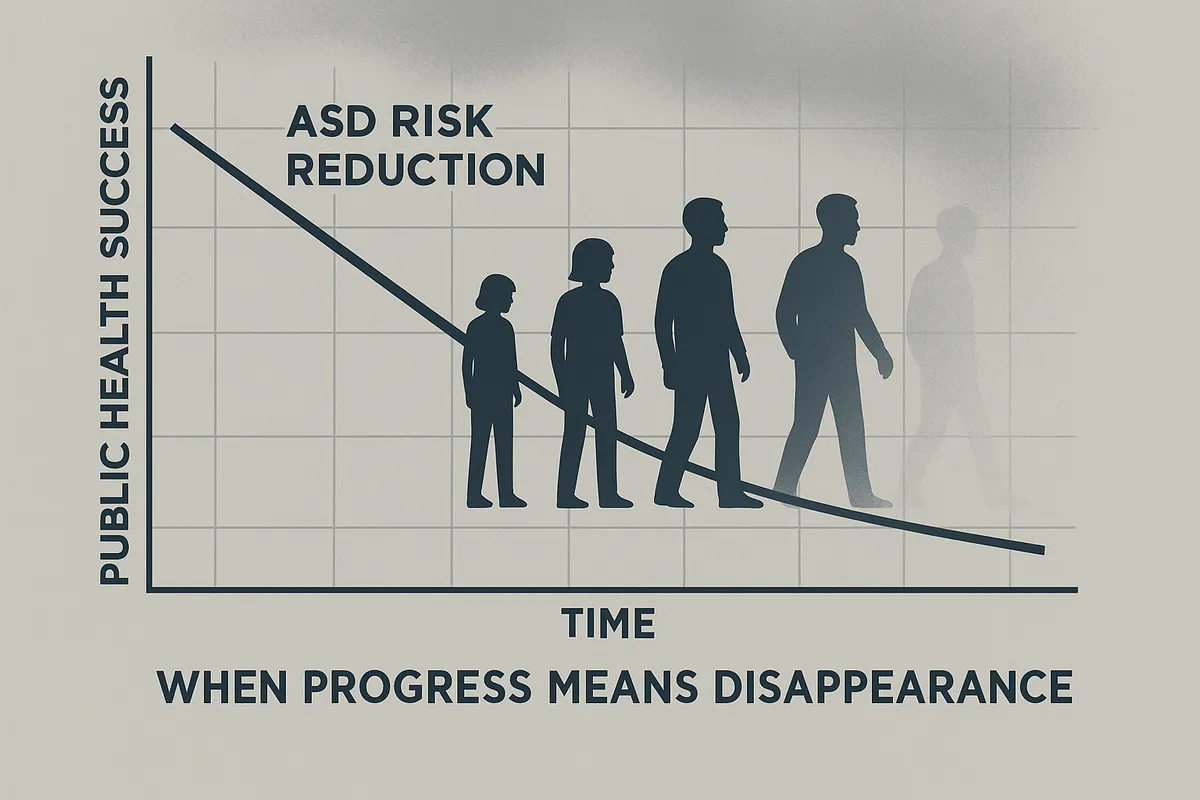
Epidemiology built for elimination often measures success by absence. When sulfate levels drop and diagnostic rates decline, the graph reads as progress. What disappears from view are the people inside those rates. Autism is not a pollutant. It is a form of human variation rendered pathological when public health defines well-being by conformity to a dominant neurotype.
The erasure-enabling structure consists of funders, journals and agencies who reward predictive models that reduce labeled disorders; key performance indicators related to public health privilege incidence reduction over access; risk-prevention rhetoric secures budgets while leaving inequity intact.
The Brain That Refuses the Blueprint
The irony: the fetal brain is endlessly plastic, not fragile; it is designed to change. Genes, hormones, nutrients, immune signals and random developmental variation constantly rewire neural circuits before birth.
Stress hormones calibrate emotion systems. Nutrition and oxygen shape synapse growth. Sound, motion and immune chemistry already begin sculpting perception. These forces don’t just create vulnerability; they create diversity. Difference is part of the natural design, not a flaw to be filtered out — except, apparently, with autism, or so say the scientists who come up with studies like this one.
Pollution can also shape development — but unlike other prenatal factors, it damages tissue. Genes provide a range of possible architectures; environment and timing sculpt within that range. These influences create difference without creating disorder.
When studies conflate the two, they flatten every neural outcome that strays from the social median. The harm mechanism is subtle: pathologize variance, then label prevention as virtue. The beneficiary is structural — agencies rewarded for reducing diagnostic categories rather than dismantling inequity.
Rebuilding the Frame
A constructive frame would separate harm from identity. Clean air matters because toxins damage tissue, not because they create autistic people. Protecting developing brains should never mean deciding which brains are worth protecting. Environmental policy can target pollution without targeting difference.
Whose Air? Whose Story?
A justice-based reframing would ask: who breathes the dirtiest air and why? The same urban, low-income and racialized communities already facing structural harm. When autism data are extracted from those contexts without addressing power the research reproduces inequality under a biomedical gloss.
The Choice Between Molecules and Ethics
Science can model molecules or it can model ethics. Doing both requires language that names systems, not scapegoats. The critique here is aimed at the language and incentives of scientific practice, not at individual researchers. The ethical metric isn’t fewer autistic children — it’s fewer poisoned environments. Measure well-being, not normalcy. Protect every way a mind can grow. Don't try to wipe that natural variation out of existence.