Autism Erasure Packaged, Delivered and Predicted
 When “Early” Means Before We Exist
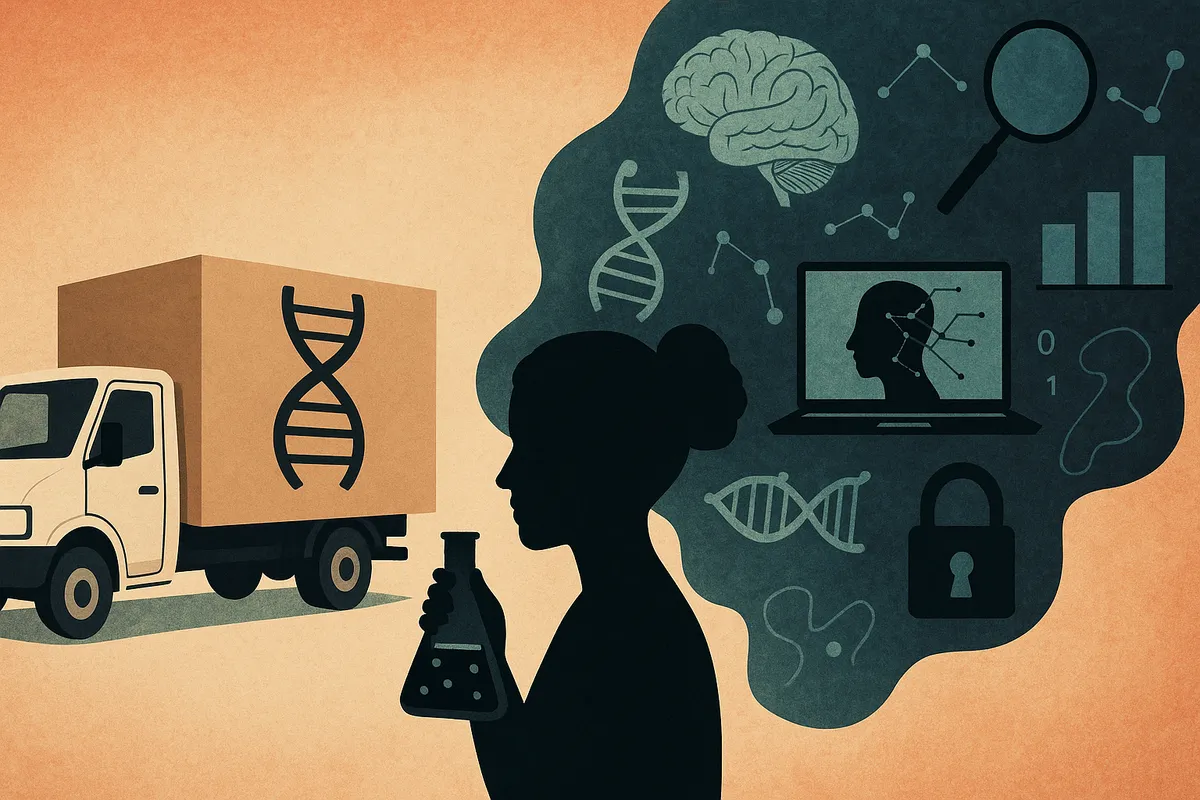
A study out of Purdue University examines the feasibility and acceptability of home-based collection of biological and environmental samples related to later autism diagnosis. The authors explicitly note that there is not yet a clear predictive association between genetics, environment and autism. The paper’s goal is exploratory, assessing how acceptable such methods are to potential participants rather than promoting predictive testing. Still, its framing — gathering “presymptomatic data” to better understand “autism likelihood” — leans toward an anticipatory view of autism. We call that preemptive because it treats autistic identity as something to be quantified before it is lived.
The team interviewed twenty-two mothers or future mothers including autistic mothers and one autistic woman planning to have children about willingness to collect samples such as blood, stool, baby teeth and environmental dust for a home kit. The study positions this as groundwork for building large, diverse datasets to examine links between genetics, environment and later autism diagnosis while acknowledging current predictive limits and ethical concerns.
The Data Before the Person
The paper describes data aggregation and sampling as a potential path toward inclusion, suggesting that with community “buy-in,” detection could “foster support and inclusion of autistic people.” Yet this logic treats inclusion as a product of extraction rather than a practice of shared authority. Autistic people appear primarily as subjects from whom data can be collected, not as co-authors defining what counts as understanding.
Each step of the proposed model — from cheek swabs to soil samples — feeds an infrastructure that merges biology and environment under a banner of early detection. Even with clear disclaimers that prediction is not yet possible, the research trajectory drifts toward surveillance and control: a way to manage future difference rather than to understand present experience.
The recurring term interestholder reinforces this distance. It classifies participants by their relationship to data value, describing mothers, caregivers or future parents while autistic people themselves remain peripheral to authorship and design decisions.
The Politeness of Erasure
The paper’s “Community Involvement Statement” acknowledges that no autistic individuals were directly involved in the development of this project. Listing neurodivergent authors and mothers of neurodivergent children does not replace autistic leadership. It becomes proxy participation, an ethical checkbox that still centers non-autistic control. You cannot ethically design studies about autistic futures without ceding some authority to autistic people in the present.
The Problem With “Acceptability”
The paper reports that participants were generally willing to collect all samples and concludes that “interestholders are open to participating in at-home data collection.” Recruitment occurred through flyers, social media, recontact lists, volunteer platforms and snowball sampling. There was no explicit screening for medicalization or attitudes toward research. Still, framing this willingness as “acceptability” can blur consent with compliance. When the baseline assumption is that autism requires early intervention, even neutral participation is shaped by that frame. The same study also documents nuanced concerns about collection difficulty, privacy, ethics and burden that complicate any reading of unconditional support.
What the Paper Teaches Us
Eugenic logic no longer needs slogans; it evolves through design. Here, the rhetoric of participation and inclusivity masks a data infrastructure built without autistic framing power. The result looks participatory but isn’t. It’s polite. It’s published. It’s incomplete. The authors’ acknowledgment of predictive uncertainty and ethical risks (stigma, false positives) tempers the claims but doesn’t change the direction of travel, a research pathway still leaning toward predictive control.
The Reframe
The paper mentions privacy and AI ethics but mostly as brief reassurances rather than structural critiques. The broader field’s fascination with “big data” reframes surveillance as innovation, normalizing massive aggregation of personal information in the name of progress. Mapping futures through algorithmic risk turns autistic life into a dataset to be optimized rather than a narrative to be heard.
If autism research wants to understand how biology and environment interact, it should start after autistic people exist in the story led by autistic questions about adaptation, access and lived experience. Ethics begins when those studied are trusted as narrators and co-designers. Until then, no matter how advanced the kit, you’re still collecting samples, not consent.
Autism doesn’t need earlier detection. It needs earlier respect.