Autism Charities Frame Power and Pity
 Study Exposes How Institutional Narratives Shape Public Understanding of Autism
In late October 2025 a PLOS ONE paper by Helen Abnett, Kathryn Williams, Willow Holloway and Aimee Grant quietly shifted the ground under Britain’s autism sector. It didn’t announce a cure or a crisis. It simply read what charities wrote about autistic people and asked what those words revealed. What the authors found should make anyone working in autism policy pause before writing another “support” statement or fundraising appeal.
The team examined the annual reports of eleven major autism charities in England and Wales including the National Autistic Society and Ambitious About Autism. These are not marginal players. They run schools, shape policy and act as government consultants. In that position of moral authority their language carries weight. The authors — an autistic-majority research team — treated that language as data.
The Frame They Found
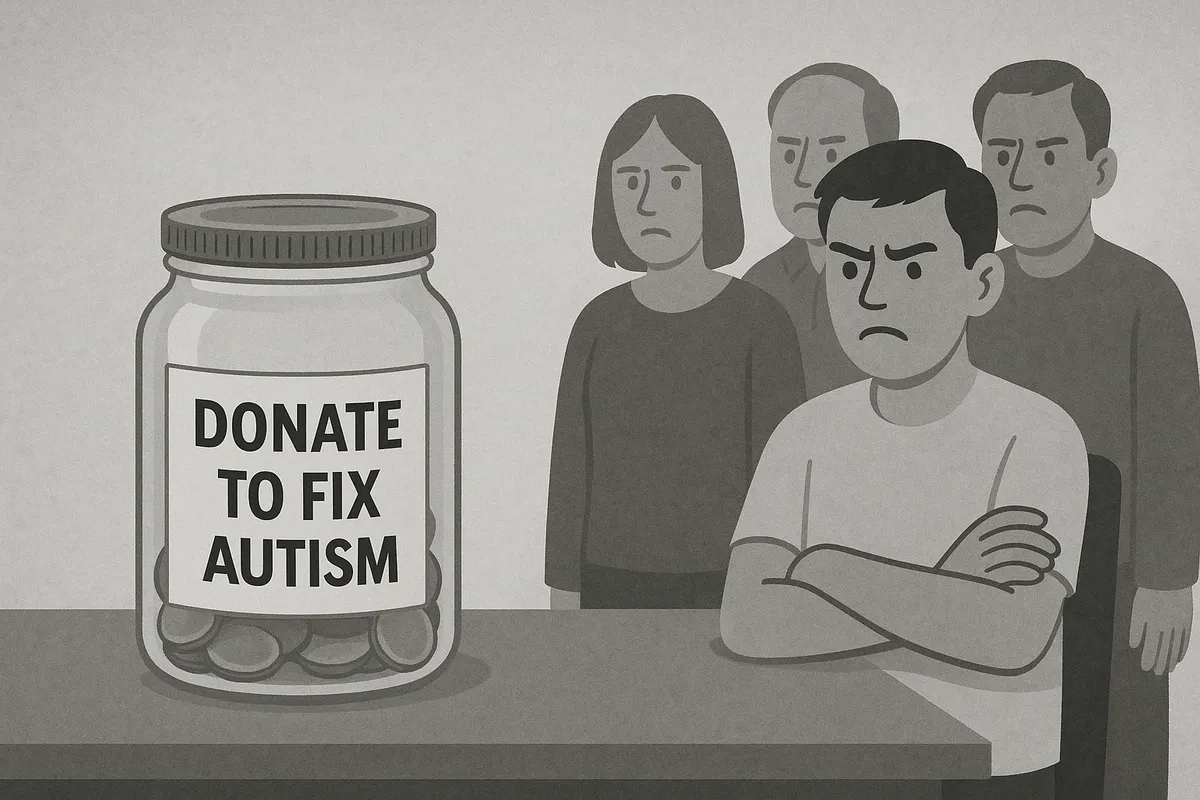
Across all eleven charities the pattern was consistent: autism was described as adversity, autistic people as challenges and the charities themselves as solutions. Trustees’ reports spoke of “complex needs,” “challenging behaviours” and “dependence.” One charity even described autistic traits as a “commercial asset,” reducing human difference to productivity. Photographs tended to infantilize or anonymize autistic people while presenting staff as calm experts. The charities appeared as both heroic and underfunded.
Autistic people meanwhile were portrayed as burdensome clients in need of transformation. The reports praised “independence,” “confidence” and “resilience” as goals — language that sounds supportive until you notice its direction. The implied call to action was never for society to adapt but for autistic people to change. Even when barriers were mentioned responsibility drifted back to the individual. The story was clear: we are the problem; they are the fix.
Charity As Moral Filter
This framing reflects the persistence of the charity model of disability which casts disabled people as recipients of benevolence rather than holders of rights. The study links this to the medical model where disability is located in the person rather than the environment. When a charity describes itself as rescuing autistic people from their condition it reinforces both models at once. The authors call this the “charity saviour” trope.
That trope is powerful because it feels generous. It reassures donors that care equals control, that giving equals fixing and that expertise belongs to those who write the reports rather than those who live the realities. It also keeps the money flowing in a system where most funding depends on government contracts. Each year charities must prove need. Portraying autistic people as perpetually needy keeps the narrative — and the funding — alive.
Study Shifts the Frame
What makes this paper remarkable is not just its findings but its method. It was conducted by an autistic-majority team using a reflexive critical approach that treats language as an instrument of power. Instead of presenting neutrality as objectivity the researchers name their standpoint and use it to expose bias. They show that neutrality often protects the status quo.
When the team translated their findings for a broader audience in The Conversation they kept the same clarity. They described how charity communications “portray autistic people as a problem” while charities cast themselves as “the solution.”
Unlike many academic critiques this one speaks plainly: autism charities are upholding the same disabling barriers they claim to remove. The authors do not stop at diagnosis. They suggest direction. Charities should challenge deficit logic, replace pity with partnership and recruit autistic people not as tokens but as decision-makers.
What Harm Remains
The contrast is sharp when you return to the charity reports themselves. They show a pattern of compliance-first language wrapped in benevolence. Words like support and treatment appear beside images of smiling staff and anonymous service users. Behavioural control methods such as Positive Behaviour Support are presented as compassion. Even when restraint appears in photos captions describe it as care. The harm here is structural not intentional — but harm does not require malice. It only needs repetition.
Each charity justifies its existence by describing autistic life as a permanent emergency. That rhetorical dependency ensures that the problem must never end. As the researchers point out the more helpless the portrayal the more indispensable the organization appears. This is the quiet economy of pity: to sustain legitimacy the charity must keep its beneficiaries small.
Where Representation Stops Short
The study also tracked who appears in each report. Out of 151 photographs only nine clearly depict autistic service users. Most show staff, trustees or donors. Even praise is filtered through non-autistic intermediaries — family members, social workers, professionals. Autistic people are not absent; they are ventriloquized. When their voices do appear it is because the charity “gave” them one. As the authors note that is not participation. It is performance.
This dynamic mirrors what many autistic advocates have long described as narrative control: who defines autism and who gets erased in the process. The reports reveal a system where language of care conceals structures of authority. Charity becomes both messenger and mask.
Turning the Mirror Around
The power of this study lies not only in critique but in example. It shows that autistic-led research can speak with precision and courage naming structural harm without euphemism. It demonstrates that reflexivity can clarify rather than blur and that telling the truth about language is a form of care.
For charities willing to listen the message is not condemnation. It is invitation. Autistic people do not need saving. We need accuracy, equity and access to our own narratives. The next time a charity drafts a report it should ask a simpler question: Whose story is this — and who benefits from the way it’s told?